Products Category
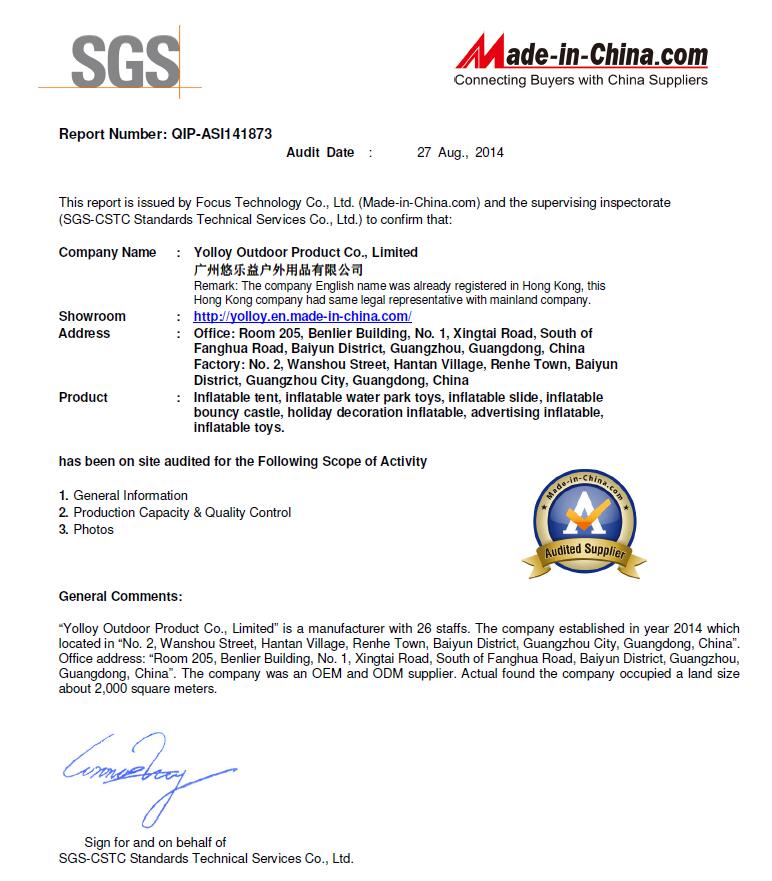
Certification

News

• New Order Successfully Finished for Long-Time Cooperated Japanese Client | YOLLOY Wins Full Client Recognition

• YOLLOY Custom Inflatable Pool Tent for Danish Client: Professional Pool Repair Shelter & Debris Protection

• Trusted Once Again! Greek Captain Re-orders Our Products After 4 Years

• Revolutionize Your Outdoors: The All-Terrain Inflatable Floating Tent for Land & Water

• Elevate Your Summer Fun: The Ultimate Inflatable Water Floating Volleyball Court Trampoline

• Innovative Inflatable Nightclub Tents & Pop-Up Bars: The Ultimate Solution for Portable Party Venues

Contact Us

Name: Sunny Yang
Tel: +86-20-8370 0771
Fax: +86-20-8370 0771
Mobile: 13570587575
E-mail: [email protected]
Add: No 5,Xiong wei Bo Nan Road,ZhongLuoTan Town,Baiyun district,Guangzhou,China
Friend me on Facebook Follow me on Twitter Add me to your circles Follow me on Pinterest Watch my channel on YouTube
News

How does an inflatable tent factory produce durable products?

Author:yolloy Date:2026/8/14 21:57:54

When you invest in an inflatable tent — whether for camping, events, commercial use, or emergency response — durability is not just a feature; it is the foundation of safety, brand reputation, and return on investment. A well-made inflatable tent can serve reliably for years across diverse environments, from sun-scorched beaches to windy mountain campsites. But what exactly goes into producing a tent that lasts? This article takes you inside the production process of a professional inflatable tent factory to reveal how quality is built in at every stage.

1. Material Selection: The Starting Point of Durability

No manufacturing process can compensate for poor raw materials. Leading inflatable tent manufacturers begin with carefully sourced, commercial-grade materials selected for the specific demands of each product category.

For heavy-duty inflatable tents, commercial-grade PVC tarpaulin is the most common choice. It offers excellent tensile strength, abrasion resistance, and weatherproofing. For lighter applications such as camping tents, factories may use Oxford fabric, nylon, or TPU (thermoplastic polyurethane) — materials that balance weight with durability. The material selection is tailored to the tent's intended use: a family camping tent needs different fabric properties than an industrial spray booth or a military shelter.

At YOLLOY, every batch of raw material is verified before production begins. The factory's materials have passed EN71, EN14960, and RoHS compliance testing, ensuring they meet international safety and environmental standards. This upfront quality gate prevents substandard fabric from ever reaching the cutting table.

2. Design and Engineering: Building Durability on Paper First

The journey to a durable inflatable tent starts long before any fabric is cut. The design phase determines the structural integrity of the final product. Engineers use professional software to model the tent's air column layout, stress distribution, and load-bearing points.

Two primary air column designs dominate the industry: multi-chamber independent structures and single-air-column bending structures. Multi-chamber designs offer superior safety — if one chamber is compromised, the others continue to hold the structure. Single-column designs provide faster setup. The choice depends on the product's intended application and the customer's priorities.

YOLLOY's design team prepares simulation renderings from customer proposals, revising the design until full approval is received. This collaborative approach ensures that every tent is engineered for its specific environment — whether it is a best inflatable tent for a glamping resort or a specialized enclosure for a golf simulator. Custom sizes, colors, logos, and artwork are all accommodated during this phase.

3. Precision Cutting: Accuracy at the Millimeter Level

Once the design is finalized, automated cutting systems take over. The design drawings are loaded into computer-controlled cutting machines that precisely cut each fabric panel according to the specifications. For the air column components, cutting accuracy is especially critical — the bending angles must be exact to the millimeter. Even a small deviation can cause uneven stress distribution after inflation, leading to premature wear or failure at the seams.

After cutting, all components are sorted by specification and moved to the next production stage. This organized workflow ensures that no piece is misplaced and that every panel is traceable throughout the manufacturing process.

4. Heat Sealing and Welding: The Core of Airtight Construction

This stage is what separates a professional inflatable product from a basic one. Traditional sewing creates needle holes that compromise airtightness. Instead, high-quality inflatable tent factories use high-frequency heat sealing (also called high-frequency welding or fusion).

The process works by stacking two layers of PVC-coated fabric on a specialized mold, then applying a high-frequency electromagnetic field. The molecular friction generates heat that melts the two layers into a single, fused bond. The resulting seam is often stronger than the surrounding material itself. This technology eliminates the risk of pinhole leaks and creates a completely airtight seal.

YOLLOY's factory is equipped with high-temperature fusion and welding equipment specifically designed for airtight products. Key stress-bearing areas — such as corners, valve connections, and air column intersections — receive additional reinforcement during this stage.

5. Sewing and Assembly: Reinforcing Every Connection

For non-airtight components — the outer tent body, groundsheet, door panels, and accessory attachments — precision sewing remains the preferred method. Skilled workers use industrial sewing machines with waterproof nylon thread and apply consistent stitch spacing throughout.

What makes the difference at this stage is the reinforcement strategy. All major stress seams receive double or even quadruple stitching. High-load areas — such as guy-line attachment points, D-ring anchor positions, and zipper interfaces — are reinforced with bar-tack stitching or additional fabric layers. After sewing, seams are sealed with waterproof tape to prevent moisture ingress through needle holes.

YOLLOY incorporates D-ring and round metal anchor systems at installation points, providing reliable wind resistance and secure ground anchoring. Each inflatable product also comes with a repair kit, giving users the ability to handle minor field repairs without compromising the tent's integrity.

6. Quality Control: Testing Before It Leaves the Factory

No inflatable tent should leave the factory without passing a rigorous testing protocol. Professional manufacturers conduct multiple checks before packaging:

  • Air Tightness Test: The tent is inflated to working pressure and left standing for 24 hours. Any pressure drop beyond the allowable threshold triggers a full inspection and rework.
  • Seam Strength Inspection: Random samples from each production batch are subjected to tensile testing at welded and sewn seams to verify bond integrity.
  • Accessory Function Check: Zippers, valves, buckles, and blowers are operated repeatedly to confirm smooth performance under real-world conditions.
  • Visual Inspection: Each product is examined for cosmetic defects, print alignment, and overall finish quality.

YOLLOY's blowers are supplied to meet CE or UL requirements and are available for 110V, 220V, or 380V electrical systems, ensuring compatibility with the customer's local power standards. The combination of certified blowers and thoroughly tested tents means the entire system — structure and inflation — is verified as a complete unit.

7. Certifications and Compliance: Proof of Quality

Certifications are a tangible indicator of a factory's commitment to quality. Reputable inflatable tent manufacturers hold their products to recognized international standards. For inflatable toys and recreational products, EN 14960 is the relevant European standard. For inflatable water park equipment, EN 15649 applies. Material safety is covered by EN71 and RoHS compliance.

These certifications are not one-time achievements — they require ongoing compliance and periodic re-testing, which means the factory must maintain consistent production standards year after year.

8. Packaging and Shipping: Protection Beyond the Factory Gate

Durability does not end at the factory door. How a tent is packaged directly affects the condition in which it arrives. YOLLOY uses a layered packaging approach: soft carpet protection immediately around the product, followed by waterproof PVC bags, and an outer layer of PE film. Large or heavy products are secured on steel pallets for additional protection during transit.

Customers can choose between air shipping (approximately 5–7 days) and sea shipping (15–30 days or more), depending on their timeline and budget. The company reports a 95% on-time delivery rate, reflecting organized production scheduling and reliable logistics partnerships.

Key Durability Factors at a Glance: Material quality → Design engineering → Precision cutting → Heat-sealed airtight seams → Reinforced sewing → Multi-point quality testing → Certified compliance → Protective packaging. Each link in this chain matters. A single weak point can compromise the entire product.

9. What Sets a Professional Factory Apart

When evaluating inflatable tent manufacturers, several factors distinguish a factory that produces genuinely durable products from one that cuts corners:

  • Custom design capability: The ability to create tents from a description, sketch, or photograph — not just assemble from a fixed catalog — shows deep engineering competence.
  • Low minimum order quantity: A factory that accepts orders starting from a single piece (as YOLLOY does) is confident enough in its production process to serve both prototype and bulk clients.
  • Transparent production timelines: Honest lead times (6–15 days for standard products) indicate a well-organized workshop rather than an overpromising sales team.
  • Comprehensive after-sales support: A repair kit with every product, a stated warranty expectation (3 years when used correctly), and 24-hour response to inquiries demonstrate accountability beyond the sale.

Producing a durable inflatable tent is a discipline that combines material science, precision engineering, skilled craftsmanship, and uncompromising quality control. When you source from a professional inflatable tent factory like YOLLOY, you are investing in a product built to perform reliably across years of use — whether it stands on a beach, in a park, at a trade show, or on a mountain campsite. To discuss your custom inflatable tent requirements, reach out to the YOLLOY team at [email protected] or visit the website to explore the full product range.

How does an inflatable tent factory produce durable products?

Author:yolloy Date:2026/8/14 21:57:54

When you invest in an inflatable tent — whether for camping, events, commercial use, or emergency response — durability is not just a feature; it is the foundation of safety, brand reputation, and return on investment. A well-made inflatable tent can serve reliably for years across diverse environments, from sun-scorched beaches to windy mountain campsites. But what exactly goes into producing a tent that lasts? This article takes you inside the production process of a professional inflatable tent factory to reveal how quality is built in at every stage.

1. Material Selection: The Starting Point of Durability

No manufacturing process can compensate for poor raw materials. Leading inflatable tent manufacturers begin with carefully sourced, commercial-grade materials selected for the specific demands of each product category.

For heavy-duty inflatable tents, commercial-grade PVC tarpaulin is the most common choice. It offers excellent tensile strength, abrasion resistance, and weatherproofing. For lighter applications such as camping tents, factories may use Oxford fabric, nylon, or TPU (thermoplastic polyurethane) — materials that balance weight with durability. The material selection is tailored to the tent's intended use: a family camping tent needs different fabric properties than an industrial spray booth or a military shelter.

At YOLLOY, every batch of raw material is verified before production begins. The factory's materials have passed EN71, EN14960, and RoHS compliance testing, ensuring they meet international safety and environmental standards. This upfront quality gate prevents substandard fabric from ever reaching the cutting table.

2. Design and Engineering: Building Durability on Paper First

The journey to a durable inflatable tent starts long before any fabric is cut. The design phase determines the structural integrity of the final product. Engineers use professional software to model the tent's air column layout, stress distribution, and load-bearing points.

Two primary air column designs dominate the industry: multi-chamber independent structures and single-air-column bending structures. Multi-chamber designs offer superior safety — if one chamber is compromised, the others continue to hold the structure. Single-column designs provide faster setup. The choice depends on the product's intended application and the customer's priorities.

YOLLOY's design team prepares simulation renderings from customer proposals, revising the design until full approval is received. This collaborative approach ensures that every tent is engineered for its specific environment — whether it is a best inflatable tent for a glamping resort or a specialized enclosure for a golf simulator. Custom sizes, colors, logos, and artwork are all accommodated during this phase.

3. Precision Cutting: Accuracy at the Millimeter Level

Once the design is finalized, automated cutting systems take over. The design drawings are loaded into computer-controlled cutting machines that precisely cut each fabric panel according to the specifications. For the air column components, cutting accuracy is especially critical — the bending angles must be exact to the millimeter. Even a small deviation can cause uneven stress distribution after inflation, leading to premature wear or failure at the seams.

After cutting, all components are sorted by specification and moved to the next production stage. This organized workflow ensures that no piece is misplaced and that every panel is traceable throughout the manufacturing process.

4. Heat Sealing and Welding: The Core of Airtight Construction

This stage is what separates a professional inflatable product from a basic one. Traditional sewing creates needle holes that compromise airtightness. Instead, high-quality inflatable tent factories use high-frequency heat sealing (also called high-frequency welding or fusion).

The process works by stacking two layers of PVC-coated fabric on a specialized mold, then applying a high-frequency electromagnetic field. The molecular friction generates heat that melts the two layers into a single, fused bond. The resulting seam is often stronger than the surrounding material itself. This technology eliminates the risk of pinhole leaks and creates a completely airtight seal.

YOLLOY's factory is equipped with high-temperature fusion and welding equipment specifically designed for airtight products. Key stress-bearing areas — such as corners, valve connections, and air column intersections — receive additional reinforcement during this stage.

5. Sewing and Assembly: Reinforcing Every Connection

For non-airtight components — the outer tent body, groundsheet, door panels, and accessory attachments — precision sewing remains the preferred method. Skilled workers use industrial sewing machines with waterproof nylon thread and apply consistent stitch spacing throughout.

What makes the difference at this stage is the reinforcement strategy. All major stress seams receive double or even quadruple stitching. High-load areas — such as guy-line attachment points, D-ring anchor positions, and zipper interfaces — are reinforced with bar-tack stitching or additional fabric layers. After sewing, seams are sealed with waterproof tape to prevent moisture ingress through needle holes.

YOLLOY incorporates D-ring and round metal anchor systems at installation points, providing reliable wind resistance and secure ground anchoring. Each inflatable product also comes with a repair kit, giving users the ability to handle minor field repairs without compromising the tent's integrity.

6. Quality Control: Testing Before It Leaves the Factory

No inflatable tent should leave the factory without passing a rigorous testing protocol. Professional manufacturers conduct multiple checks before packaging:

  • Air Tightness Test: The tent is inflated to working pressure and left standing for 24 hours. Any pressure drop beyond the allowable threshold triggers a full inspection and rework.
  • Seam Strength Inspection: Random samples from each production batch are subjected to tensile testing at welded and sewn seams to verify bond integrity.
  • Accessory Function Check: Zippers, valves, buckles, and blowers are operated repeatedly to confirm smooth performance under real-world conditions.
  • Visual Inspection: Each product is examined for cosmetic defects, print alignment, and overall finish quality.

YOLLOY's blowers are supplied to meet CE or UL requirements and are available for 110V, 220V, or 380V electrical systems, ensuring compatibility with the customer's local power standards. The combination of certified blowers and thoroughly tested tents means the entire system — structure and inflation — is verified as a complete unit.

7. Certifications and Compliance: Proof of Quality

Certifications are a tangible indicator of a factory's commitment to quality. Reputable inflatable tent manufacturers hold their products to recognized international standards. For inflatable toys and recreational products, EN 14960 is the relevant European standard. For inflatable water park equipment, EN 15649 applies. Material safety is covered by EN71 and RoHS compliance.

These certifications are not one-time achievements — they require ongoing compliance and periodic re-testing, which means the factory must maintain consistent production standards year after year.

8. Packaging and Shipping: Protection Beyond the Factory Gate

Durability does not end at the factory door. How a tent is packaged directly affects the condition in which it arrives. YOLLOY uses a layered packaging approach: soft carpet protection immediately around the product, followed by waterproof PVC bags, and an outer layer of PE film. Large or heavy products are secured on steel pallets for additional protection during transit.

Customers can choose between air shipping (approximately 5–7 days) and sea shipping (15–30 days or more), depending on their timeline and budget. The company reports a 95% on-time delivery rate, reflecting organized production scheduling and reliable logistics partnerships.

Key Durability Factors at a Glance: Material quality → Design engineering → Precision cutting → Heat-sealed airtight seams → Reinforced sewing → Multi-point quality testing → Certified compliance → Protective packaging. Each link in this chain matters. A single weak point can compromise the entire product.

9. What Sets a Professional Factory Apart

When evaluating inflatable tent manufacturers, several factors distinguish a factory that produces genuinely durable products from one that cuts corners:

  • Custom design capability: The ability to create tents from a description, sketch, or photograph — not just assemble from a fixed catalog — shows deep engineering competence.
  • Low minimum order quantity: A factory that accepts orders starting from a single piece (as YOLLOY does) is confident enough in its production process to serve both prototype and bulk clients.
  • Transparent production timelines: Honest lead times (6–15 days for standard products) indicate a well-organized workshop rather than an overpromising sales team.
  • Comprehensive after-sales support: A repair kit with every product, a stated warranty expectation (3 years when used correctly), and 24-hour response to inquiries demonstrate accountability beyond the sale.

Producing a durable inflatable tent is a discipline that combines material science, precision engineering, skilled craftsmanship, and uncompromising quality control. When you source from a professional inflatable tent factory like YOLLOY, you are investing in a product built to perform reliably across years of use — whether it stands on a beach, in a park, at a trade show, or on a mountain campsite. To discuss your custom inflatable tent requirements, reach out to the YOLLOY team at [email protected] or visit the website to explore the full product range.