Products Category
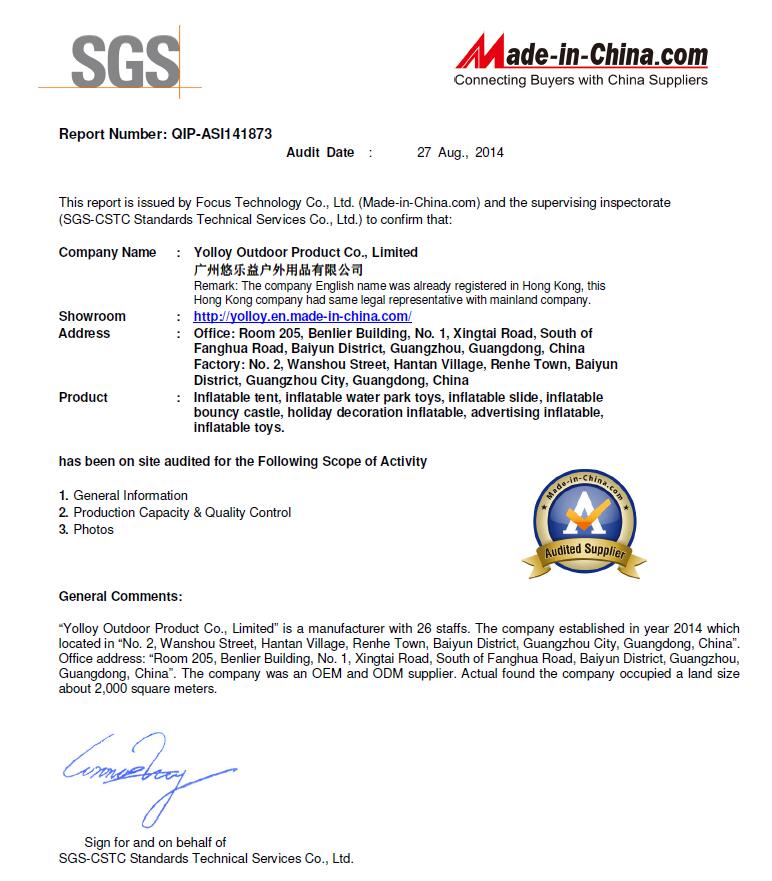
Certification

News

• New Order Successfully Finished for Long-Time Cooperated Japanese Client | YOLLOY Wins Full Client Recognition

• YOLLOY Custom Inflatable Pool Tent for Danish Client: Professional Pool Repair Shelter & Debris Protection

• Trusted Once Again! Greek Captain Re-orders Our Products After 4 Years

• Revolutionize Your Outdoors: The All-Terrain Inflatable Floating Tent for Land & Water

• Elevate Your Summer Fun: The Ultimate Inflatable Water Floating Volleyball Court Trampoline

• Innovative Inflatable Nightclub Tents & Pop-Up Bars: The Ultimate Solution for Portable Party Venues

Contact Us

Name: Sunny Yang
Tel: +86-20-8370 0771
Fax: +86-20-8370 0771
Mobile: 13570587575
E-mail: [email protected]
Add: No 5,Xiong wei Bo Nan Road,ZhongLuoTan Town,Baiyun district,Guangzhou,China
Friend me on Facebook Follow me on Twitter Add me to your circles Follow me on Pinterest Watch my channel on YouTube
News

How does an inflatable bounce house water park differ from a regular water park?

Author:yolloy Date:2026/8/19 16:56:41

When summer heat peaks, the same question comes up in backyards, resort planning meetings, and event budgets: plan a day at a traditional water park, or go a different route? An inflatable bounce house water park sits somewhere between a playground and a water attraction. It blends the cheerful, jumping energy of a bouncer with splash pools, slides, and climbing elements, yet it works in ways a permanent concrete park simply cannot. Understanding those differences helps families choose a fun day out and helps operators decide which format earns its place in their business.

What each one actually is

A regular water park is a permanent or semi-permanent facility built into a fixed site. It uses engineered slides, wave pools, lazy rivers, splash pads, and heavy filtration and pumping systems, all of which demand civil works, permits, and long construction timelines. Once it is built, it stays where it is and welcomes visitors year after year as a destination attraction.

An inflatable bounce house water park, by contrast, is a modular, air-filled setup. It pairs a bouncy jumping zone with water features such as splash pools, spray areas, and attached slides, all supported by continuous inflation from blowers and anchored to the ground or a pool floor. Operators can bring it to a backyard, a lake shore, a resort lawn, or a city plaza, and they can take it down and move it when the season ends. This portability is the biggest reason a water fun area exists at all in many locations that could never justify a permanent park.

Setup, space, and investment

The installation gap is enormous. A traditional park needs land, engineering, water-treatment infrastructure, electrical systems, and months of construction before the first guest arrives. An inflatable water park inflates in minutes with the right blower and can run the same day. This lower entry cost opens the format to seasonal businesses, event planners, hotels, and community programs that could never fund a capital-heavy attraction.

Because the whole setup is movable, revenue is not tied to one fixed location. A rental operator can serve a birthday party one weekend and a community festival the next, spreading income across multiple sites in a single season. Custom size and color options let a buyer order an inflatable water park to fit the exact space available, whether that is a compact poolside spot or a wide open field.

The play experience

The type of fun differs as well. A regular park focuses on water flow: high-speed flumes, large pools, and long queues for major attractions. An inflatable bounce house water park keeps the focus on active, bouncy play. Kids jump on springy floors, race through splash areas, climb small walls, and shoot down attached slides into a cool pool. The soft, air-filled surfaces absorb the impact of running and leaping, which suits younger children and adds a carefree, festival energy that a fixed concrete park rarely matches.

Many operators mix themes to keep things fresh, pairing a water park with a bouncy castle or slide so volumes build. For example, a double-lane water slide with an attached pool gives older kids the thrill of a slide while a separate bounce zone keeps smaller guests entertained, so a single setup serves a wider age range. This flexibility makes the inflatable option a strong draw for family events and busy rental days.

Safety, materials, and protection

Both formats must be managed carefully, but the risks differ. A permanent park controls water quality with large filtration and chemical systems and relies on engineered structures and trained lifeguards. An inflatable water park depends on anchoring, correct inflation, and durable materials. Reputable suppliers build commercial-grade units from heavy-duty PVC tarpaulin, reinforce seams at high-load points, and incorporate anchor systems such as D-rings or round metal anchors to keep the structure stable in wind. YOLLOY materials have passed EN71, EN14960, and RoHS-related testing, and its inflatable water-park products reference EN 15649, so buyers can verify compliance rather than guess.

Operators still control the real-world safety margin. Setting clear weight limits, supervising young swimmers, and checking anchors and blowers before every session matter more than the format itself. A repair kit ships with each YOLLOY inflatable, and blowers are available for 110V, 220V, or 380V power, so keeping the structure topped up and leak-free is straightforward.

Maintenance and lifespan

A concrete park is built to last decades but wears slowly and expensively. An inflatable unit has a defined working life that depends on how hard it is used and how well it is stored, with a typical expectation of around three years of service when used and maintained correctly. That shorter life is offset by far lower upfront cost and the ease of swapping in a new design later. For many operators, buying an inflatable is a stepping stone: they test demand, earn seasonal revenue, and replace the unit when the next trend or a bigger space arrives.

Which one should you choose?

If the goal is a fixed, year-round regional attraction with wave pools and huge slides, a traditional park is the right answer. If the goal is flexible, affordable, mobile family fun that can start small and grow, an inflatable bounce house water park wins. Operators who move between venues or test a market seasonally should look for a supplier that offers genuine customization from a sketch or site plan, a reasonable lead time of around 6 to 15 days for a regular unit, and dependable shipping by air or sea. Working with a factory in Guangzhou has practical advantages: a faster lead time is easier to guarantee, and YOLLOY reports a 95% on-time delivery rate with emailed questions answered within 24 hours. A commercial inflatable water park from an established manufacturer brings certified materials, custom design, and support together in one package.

In short, a regular water park is permanent, expensive, and built for volume, while an inflatable bounce house water park is portable, affordable, and built for active play anywhere water and space are available. Decide first how you will use it, then let the format follow the plan.


How does an inflatable bounce house water park differ from a regular water park?

Author:yolloy Date:2026/8/19 16:56:41

When summer heat peaks, the same question comes up in backyards, resort planning meetings, and event budgets: plan a day at a traditional water park, or go a different route? An inflatable bounce house water park sits somewhere between a playground and a water attraction. It blends the cheerful, jumping energy of a bouncer with splash pools, slides, and climbing elements, yet it works in ways a permanent concrete park simply cannot. Understanding those differences helps families choose a fun day out and helps operators decide which format earns its place in their business.

What each one actually is

A regular water park is a permanent or semi-permanent facility built into a fixed site. It uses engineered slides, wave pools, lazy rivers, splash pads, and heavy filtration and pumping systems, all of which demand civil works, permits, and long construction timelines. Once it is built, it stays where it is and welcomes visitors year after year as a destination attraction.

An inflatable bounce house water park, by contrast, is a modular, air-filled setup. It pairs a bouncy jumping zone with water features such as splash pools, spray areas, and attached slides, all supported by continuous inflation from blowers and anchored to the ground or a pool floor. Operators can bring it to a backyard, a lake shore, a resort lawn, or a city plaza, and they can take it down and move it when the season ends. This portability is the biggest reason a water fun area exists at all in many locations that could never justify a permanent park.

Setup, space, and investment

The installation gap is enormous. A traditional park needs land, engineering, water-treatment infrastructure, electrical systems, and months of construction before the first guest arrives. An inflatable water park inflates in minutes with the right blower and can run the same day. This lower entry cost opens the format to seasonal businesses, event planners, hotels, and community programs that could never fund a capital-heavy attraction.

Because the whole setup is movable, revenue is not tied to one fixed location. A rental operator can serve a birthday party one weekend and a community festival the next, spreading income across multiple sites in a single season. Custom size and color options let a buyer order an inflatable water park to fit the exact space available, whether that is a compact poolside spot or a wide open field.

The play experience

The type of fun differs as well. A regular park focuses on water flow: high-speed flumes, large pools, and long queues for major attractions. An inflatable bounce house water park keeps the focus on active, bouncy play. Kids jump on springy floors, race through splash areas, climb small walls, and shoot down attached slides into a cool pool. The soft, air-filled surfaces absorb the impact of running and leaping, which suits younger children and adds a carefree, festival energy that a fixed concrete park rarely matches.

Many operators mix themes to keep things fresh, pairing a water park with a bouncy castle or slide so volumes build. For example, a double-lane water slide with an attached pool gives older kids the thrill of a slide while a separate bounce zone keeps smaller guests entertained, so a single setup serves a wider age range. This flexibility makes the inflatable option a strong draw for family events and busy rental days.

Safety, materials, and protection

Both formats must be managed carefully, but the risks differ. A permanent park controls water quality with large filtration and chemical systems and relies on engineered structures and trained lifeguards. An inflatable water park depends on anchoring, correct inflation, and durable materials. Reputable suppliers build commercial-grade units from heavy-duty PVC tarpaulin, reinforce seams at high-load points, and incorporate anchor systems such as D-rings or round metal anchors to keep the structure stable in wind. YOLLOY materials have passed EN71, EN14960, and RoHS-related testing, and its inflatable water-park products reference EN 15649, so buyers can verify compliance rather than guess.

Operators still control the real-world safety margin. Setting clear weight limits, supervising young swimmers, and checking anchors and blowers before every session matter more than the format itself. A repair kit ships with each YOLLOY inflatable, and blowers are available for 110V, 220V, or 380V power, so keeping the structure topped up and leak-free is straightforward.

Maintenance and lifespan

A concrete park is built to last decades but wears slowly and expensively. An inflatable unit has a defined working life that depends on how hard it is used and how well it is stored, with a typical expectation of around three years of service when used and maintained correctly. That shorter life is offset by far lower upfront cost and the ease of swapping in a new design later. For many operators, buying an inflatable is a stepping stone: they test demand, earn seasonal revenue, and replace the unit when the next trend or a bigger space arrives.

Which one should you choose?

If the goal is a fixed, year-round regional attraction with wave pools and huge slides, a traditional park is the right answer. If the goal is flexible, affordable, mobile family fun that can start small and grow, an inflatable bounce house water park wins. Operators who move between venues or test a market seasonally should look for a supplier that offers genuine customization from a sketch or site plan, a reasonable lead time of around 6 to 15 days for a regular unit, and dependable shipping by air or sea. Working with a factory in Guangzhou has practical advantages: a faster lead time is easier to guarantee, and YOLLOY reports a 95% on-time delivery rate with emailed questions answered within 24 hours. A commercial inflatable water park from an established manufacturer brings certified materials, custom design, and support together in one package.

In short, a regular water park is permanent, expensive, and built for volume, while an inflatable bounce house water park is portable, affordable, and built for active play anywhere water and space are available. Decide first how you will use it, then let the format follow the plan.