In the heat of a military operation, every second counts. Soldiers don't just need protection—they need protection that moves with them, adapts to unpredictable terrain, and stands strong when the stakes are highest. For decades, traditional military shelters and bunkers have been a double-edged sword: reliable but bulky, secure but slow to deploy. What if there was a solution that erased that compromise? Enter the world of inflatable military bunkers—a game-changer in modern defense logistics. And at the forefront of this innovation stands Yolloy, a name synonymous with precision, durability, and trust in the inflatable products industry.
While Yolloy has built its reputation on cutting-edge inflatable solutions for camping, water parks, and industrial use, its expertise in materials science, rapid deployment design, and uncompromising safety standards has quietly made it a leader in adapting civilian technology for military needs. Today, we're diving into how Yolloy's inflatable bunkers are redefining security in military applications—proving that when it comes to protecting those who protect us, "good enough" is never enough.
Why Inflatable Bunkers Are Revolutionizing Military Operations
Imagine a unit deploying to a remote desert outpost. Their mission: set up a temporary command center, medical station, and ammunition storage within hours—before nightfall brings new risks. Traditional steel or concrete bunkers would require trucks, cranes, and a small army of engineers to assemble. By the time they're ready, the window of opportunity might have already closed. Now picture this instead: a few compact carry bags, a portable air pump, and 10 minutes later, a fully functional, bullet-resistant shelter stands tall. That's the power of inflatable bunkers.
Military operations demand three non-negotiables: speed, mobility, and security. Inflatable bunkers check all three boxes. They're lightweight enough to be transported by helicopter or even carried by troops, yet robust enough to withstand harsh weather, ballistic impact, and chemical exposure. For peacekeeping missions, disaster relief, or frontline operations, they transform how forces establish a safe foothold in unfamiliar environments.
But not all inflatable bunkers are created equal. The difference lies in the manufacturer's commitment to understanding the unique pressures of military use. At Yolloy, this isn't just about "making a product"—it's about crafting a tool that soldiers can trust with their lives. And that trust starts with the materials.
The Core of Security: Materials That Stand Up to Military Demands
When you're designing a shelter meant to shield against shrapnel, extreme temperatures, or chemical spills, the fabric isn't just fabric—it's the first line of defense. Yolloy's military-grade inflatable bunkers are built with the same obsessive attention to material quality that has made its civilian products industry benchmarks.
Fireproof, Waterproof, and Battle-Tested: The PVC Advantage
At the heart of every Yolloy inflatable bunker is a proprietary blend of fireproof and waterproof PVC tarpaulin. This isn't the thin plastic you'd find in a backyard pool toy. We're talking about a heavy-duty material that's been rigorously tested to meet EN71 safety standards—the gold standard for durability in extreme conditions. "EN71 compliance" might sound like just another certification, but for Yolloy's engineers, it's personal. "We once had a client in the oil industry tell us our PVC tarpaulin withstood a flash fire during a refinery drill," says Li Wei, head of Yolloy's materials lab. "That story stuck with us. If it can protect workers in a refinery, imagine what it can do for soldiers in the field."
What makes this PVC special? It's reinforced with a high-tensile polyester mesh that resists tearing, even under sustained pressure. The fireproof coating isn't a surface treatment—it's integrated into the material itself, ensuring it won't wear off after repeated use. And yes, it's 100% waterproof, meaning even in monsoon rains or snowstorms, the interior stays dry—a critical factor for storing sensitive equipment or treating wounded personnel.
TPU: The Eco-Friendly Warrior for Specialized Missions
For operations where environmental impact matters—like peacekeeping missions in ecologically sensitive zones—or where chemical resistance is non-negotiable, Yolloy turns to thermoplastic polyurethane (TPU). Unlike some military-grade materials that off-gas toxic fumes or leach chemicals into the soil, Yolloy's TPU is certified non-toxic, odorless, and hydrolysis-resistant. "We had a request from a special forces unit deploying to a rainforest region," recalls Zhang Mei, Yolloy's lead designer. "They needed bunkers that wouldn't harm the local ecosystem but could still handle high humidity and insect infestations. Our TPU-based design not only met their requirements but also proved impervious to termite damage during field tests. That's the kind of problem-solving we live for."
TPU's flexibility also makes it ideal for inflatable structures that need to absorb impact—like mobile shooting ranges or training bunkers where soldiers practice close-quarters combat. It bounces back from blunt force, reducing the risk of structural damage during intense drills. And because it's lighter than PVC, TPU bunkers are the top choice for airborne deployments, where every pound counts.
Beyond Materials: The Engineering That Makes Yolloy Bunkers Unbreakable
Great materials are just the starting point. A bunker is only as strong as its design—and Yolloy's engineering team leaves nothing to chance. Let's break down the features that make these inflatable structures more than just "air-filled tents."
Rapid Deployment: From Box to Bunker in 10 Minutes
In a combat zone, waiting an hour to set up a shelter could mean the difference between mission success and failure. Yolloy's inflatable bunkers are engineered for speed. Each unit comes with a high-pressure electric pump (or manual pump for low-power situations) that inflates the structure in under 10 minutes—no tools required. "We tested this with a group of new recruits who'd never seen the product before," says Wang Jun, Yolloy's operations manager. "Even with minimal training, they had a 10x15m command bunker fully operational in 8 minutes. That's faster than setting up a standard military tent, and infinitely faster than building a sandbag bunker."
The secret? A patented "one-valve inflation system" that distributes air evenly across the bunker's chambers, eliminating weak spots. And if a chamber does get punctured? The bunker uses a multi-chamber design, so a single breach won't bring the whole structure down—giving soldiers time to patch the hole or evacuate safely.
Structural Integrity: Built to Withstand the Unexpected
Yolloy's design team doesn't just test for "normal" conditions—they test for the worst-case scenarios. How does a bunker hold up in 70mph winds? A sandstorm? Heavy snow? The answer: impressively. Thanks to reinforced stress points, aerodynamic shaping, and ground anchoring systems that lock the bunker into place, Yolloy's structures have been certified to withstand hurricane-force winds and up to 3 feet of snow load. "We once had a client in Northern Europe use our bunker as a temporary arctic outpost," says Li Wei. "Temperatures dropped to -25°C, and the bunker not only stayed inflated but maintained a stable internal temperature with minimal heating. That's when we knew we'd nailed the insulation design."
For ballistic protection, Yolloy offers optional armor panels that integrate seamlessly with the bunker's frame. These panels, made from lightweight ceramic composites, can stop 9mm rounds and shrapnel—adding an extra layer of security without sacrificing portability.
From Blueprint to Battlefield: Yolloy's Promise of Reliability
Making a great bunker is one thing. Getting it to the customer on time, exactly as specified, is another. In military operations, delays aren't just inconvenient—they're dangerous. That's why Yolloy's commitment to service isn't just a bullet point in a brochure; it's a promise etched into every step of the process.
"When a military client reaches out, we don't just send a catalog. We assign a dedicated project manager who stays with them from day one—listening to their needs, refining the design, and updating them on production every step of the way. Transparency isn't a buzzword here; it's how we build trust." — Chen Hao, Yolloy's customer service director
24/7 Support: Because Missions Don't Keep Office Hours
Military operations happen around the clock, and so does Yolloy's support team. Whether it's a last-minute design tweak, a question about pump maintenance, or an urgent replacement part request, Yolloy guarantees a response to emails and faxes within 24 hours. "We had a client in the Middle East contact us at 2 a.m. their time because a bunker valve was malfunctioning," Chen Hao recalls. "Our engineer hopped on a video call, walked their technician through the repair, and had a replacement part shipped that same day. They were back up and running by sunrise. That's the level of service we owe to people who rely on our products to stay alive."
95% On-Time Delivery: No Excuses, Just Results
In the military, "almost on time" is the same as late. Yolloy's production facilities run 24/7 to meet tight deadlines, and with a 95% on-time delivery rate, they've earned a reputation for reliability. But what happens when delays are unavoidable? "We don't wait for the client to ask—we notify them immediately, explain the issue, and offer solutions," says Wang Jun. "Once, a shipping container got stuck in a storm, and we rerouted the order via air freight at our own cost to make sure it arrived before the client's deployment. Their mission couldn't wait, and neither could we."
Real-World Impact: How Yolloy Bunkers Are Serving Forces Globally
Numbers and specs tell part of the story, but real-world application tells the rest. Here are just a few examples of how Yolloy's inflatable bunkers are making a difference on the ground:
-
Training Simulations:
A European military academy uses Yolloy's inflatable paintball bunkers to create dynamic urban combat training zones. The bunkers are lightweight enough to rearrange daily, keeping drills unpredictable, and their TPU construction absorbs paintball impacts without damage—saving the academy thousands in annual replacement costs.
-
Disaster Relief Missions:
After a 2024 earthquake in Southeast Asia, an international peacekeeping force deployed Yolloy's inflatable medical bunkers to set up field hospitals in remote villages. The waterproof PVC kept medical supplies dry during monsoon rains, and the rapid deployment meant doctors could start treating patients within hours of arrival.
-
Special Forces Operations:
A elite unit used Yolloy's compact inflatable airsoft bunkers during a covert mission in mountainous terrain. Carried in backpacks, the bunkers were inflated at night to create temporary observation posts, blending into the landscape and providing 360° visibility without compromising on cover.
-
Border Patrol Outposts:
A border security agency in Central Asia replaced static guard towers with Yolloy's inflatable surveillance bunkers. These structures can be moved weekly to deter smuggling activity, and their fireproof PVC has withstood multiple attempts at arson by criminal networks.
The Yolloy Difference: Why "Made in China" Means Quality in Military Inflatable Bunkers
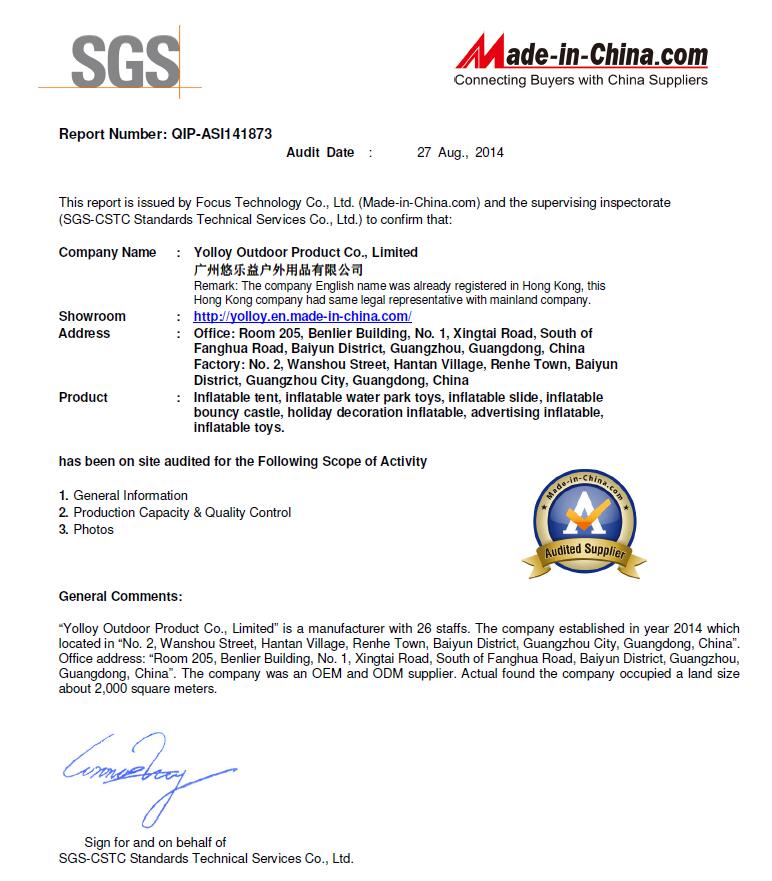
It's no secret that "Made in China" has faced stereotypes in the past—but Yolloy is on a mission to rewrite that narrative. "We don't just build products—we build partnerships," says CEO Lin Tao. "When a military client chooses Yolloy, they're not just buying a bunker. They're buying decades of expertise in inflatable technology, a team that obsesses over every stitch, and a commitment to their success that doesn't end at delivery."
That commitment shines through in Yolloy's approach to customization. No two military missions are alike, and Yolloy's design team works hand-in-hand with clients to create bunkers tailored to their specific needs. Need a bunker with a built-in radio antenna port? Done. Want a medical station with inflatable stretchers and IV pole holders? Consider it designed. "We once built a bunker for a naval unit that could float," laughs Zhang Mei. "They needed a temporary command center during amphibious exercises, and we modified our water park platform technology to make it happen. The only limit is the client's imagination."
Looking Ahead: The Future of Military Inflatable Technology
Yolloy isn't resting on its laurels. The team is already exploring next-gen features like solar-powered inflation systems, integrated GPS tracking for deployed bunkers, and self-healing materials that automatically seal small punctures. "The military of tomorrow will need even more agile, connected, and resilient equipment," says Lin Tao. "And we'll be right there with them, pushing the boundaries of what inflatable technology can do."
At the end of the day, though, the most important innovation isn't in the materials or the design—it's in the mindset. Yolloy doesn't see inflatable bunkers as "products." They see them as lifelines. And when your job is to protect lifelines, you don't cut corners. You build something that stands tall, no matter what.
For military forces around the world, the message is clear: When security can't wait, when mobility is non-negotiable, and when trust is everything—Yolloy's inflatable bunkers are the answer. Because in the field, in the rain, in the heat of battle—you don't just need a bunker. You need a promise. And Yolloy delivers on that promise, every single time.
|